 by Plaza Estates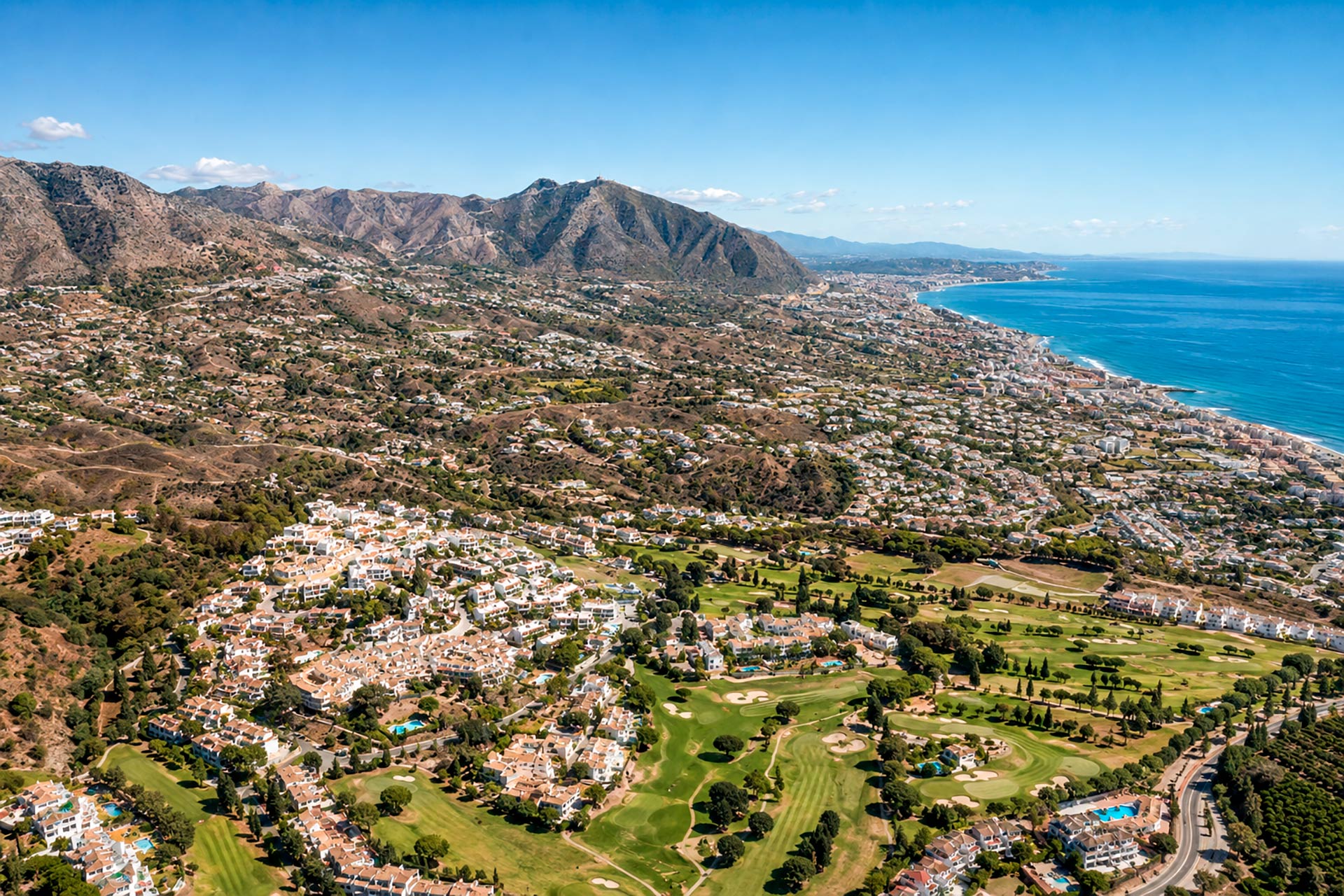
Mijas is one of the largest and most varied municipalities on the Costa del Sol, taking in the whitewashed hill village of Mijas Pueblo, the everyday town of Las Lagunas behind Fuengirola, and the coastal strip of Mijas Costa. It suits buyers who want a settled, year-round base with a genuine choice of setting, approximately 25 to 40 minutes from Málaga-Costa del Sol Airport.
Three very different Mijas
Buyers who know Mijas only from photographs tend to picture the mountain village and assume that is the municipality. In practice Mijas has three distinct nuclei, with different property stock, different daily rhythms and different price levels: Mijas Pueblo inland, Las Lagunas immediately inland of Fuengirola, and the coastal band of Mijas Costa running west to the Marbella boundary. Deciding between them matters far more than deciding between Mijas and a neighbouring municipality.
Mijas Pueblo: the inland village
Mijas Pueblo sits in the hills above the coast and is one of the best-known white villages of the Costa del Sol, with narrow cobbled streets, a historic centre and views that reach down to the Mediterranean. Property here tends to be traditional Andalusian townhouses, village apartments and villas on the surrounding hillsides, generally appealing to buyers who want a genuine village setting with easy access to the coast rather than a beachfront address.
Daily life in the pueblo revolves around its plazas, local shops and a sense of community that persists throughout the year, unlike some purely seasonal resort areas. The descent to the coast takes approximately fifteen minutes by road, so residents are not isolated from the amenities of the coastal strip or of neighbouring Fuengirola, but a car is realistically part of daily life at this altitude.
Las Lagunas: the municipality’s everyday town
Las Lagunas is the part of Mijas that international buyers most often overlook, and it is the municipality’s most populated nucleus. It lies inland of the seafront, directly against the Fuengirola boundary, and it functions as a working town rather than a resort: apartment blocks and townhouses, commercial streets, schools, sports facilities and the municipality’s main administrative and healthcare services.
For buyers, that changes the calculation. Property in Las Lagunas is predominantly apartments and townhouses, it is generally the most accessible entry point into the municipality, and it offers year-round services within walking distance in a way that the coastal urbanisations often do not. It appeals particularly to buyers relocating full-time, and to those who want to be within reach of Fuengirola’s services, including its rail connection, without paying a beachfront premium.
Mijas Costa: La Cala, Riviera del Sol and Calahonda
The greater part of the property stock in the municipality is found along the coast rather than in the pueblo. Mijas Costa covers the municipality’s entire coastline, between Fuengirola and the Marbella boundary, taking in La Cala de Mijas, Riviera del Sol, Miraflores and Calahonda, together with several golf courses set slightly inland from the beaches.
La Cala de Mijas
La Cala de Mijas has grown from a small fishing settlement into the main town of the coastal strip, with its own promenade, beaches and a mix of low-rise apartment blocks, townhouses and villas. It generally appeals to buyers looking for a walkable, beach-oriented base with a village-like town centre rather than a high-rise resort feel, and it has a resident population that stays through the winter.
Riviera del Sol and Calahonda
Riviera del Sol and Calahonda — properly Sitio de Calahonda — occupy the western end of Mijas Costa, and this is where buyers most often get the geography wrong. Calahonda runs up to the Marbella boundary and is frequently marketed alongside Marbella East, but it lies in the municipality of Mijas: Mijas town hall, Mijas planning rules and Mijas local taxes. Because municipal boundaries on this stretch of coast are not intuitive, we would always suggest confirming the municipality on the escritura and in the catastro rather than relying on how a property is advertised.
Both are large, established urbanisations developed progressively over several decades, offering a wide range of apartments, townhouses and villas, many within walking distance of the coast. They tend to attract buyers seeking a quieter, more suburban residential setting than the busier resort centres, while remaining within easy reach of the beach and local commercial areas. Property age, build quality and community charges vary considerably from one urbanisation to the next, which makes individual due diligence more important here than in a uniform development.
Property prices: what the data does and does not tell you
No official price series exists at individual nucleus level for a municipality of this size, and portal averages mix asking prices across areas that behave very differently. As a broad orientation, apartments in Las Lagunas are generally the most accessible entry point in Mijas; La Cala de Mijas commands more, particularly close to the town centre and the seafront; Riviera del Sol and Calahonda span a wide range depending on the urbanisation, the age of the property and its distance from the beach; and in Mijas Pueblo prices vary sharply between village houses in the historic centre and hillside villas with open sea views. New-build stock is concentrated on the coast and around the golf areas rather than in the village.
For market movements, the Colegio de Registradores publishes its Estadística Registral Inmobiliaria (ERI) each quarter for Málaga province, based on registered transactions rather than advertised prices, and it remains the most reliable primary reference; asking prices in established coastal markets typically run above that provincial transaction benchmark. Foreign buyers accounted for 32.8% of purchases across Málaga province in 2025 according to the same source, which reflects the region’s long-standing international appeal — though it is a provincial figure, not one specific to Mijas.
Buying costs
Purchase costs in Mijas follow the standard framework that applies across Andalucía. On a resale property, Impuesto de Transmisiones Patrimoniales (ITP) is generally charged at 7% under current Andalusian regional legislation, and the taxable base may be the administration’s reference value rather than the agreed price, so this should always be confirmed with an independent tax adviser before making an offer. On a new-build purchase, buyers instead pay IVA at 10% plus Actos Jurídicos Documentados (AJD) at approximately 1.2%, since IVA applies only to a first delivery of a new property by the developer. As a broad guide, total additional costs are commonly estimated at around 10% on a resale and around 12–13% on a new build.
| Cost item | Resale property | New-build property |
|---|---|---|
| Main transfer tax | ITP, generally 7% (Andalucía) | IVA, 10% — first delivery by the developer only |
| Documentation tax (AJD) | Not applicable; the transfer is taxed through ITP | Approximately 1.2% |
| Notary and Land Registry | Charged under regulated official scales, according to the value and complexity of the deed | |
| Legal fees | By written quotation from your chosen lawyer, stating whether IVA is included | |
| Taxable base | May be the administration’s reference value rather than the price | The price agreed with the developer |
| Approximate total additional costs | Around 10% | Around 12–13% |
If the purchase is financed, the costs of the mortgage itself are allocated separately by law: the lender bears the notary, registry, administrative and stamp duty costs of the loan deed, while the buyer pays for the valuation. These figures are a general guide only and do not constitute tax advice. Plaza Estates does not provide legal, tax or planning advice directly; we coordinate with independent lawyers and tax advisers so that buyers receive guidance specific to their own circumstances.
Healthcare, schools and getting around
Public healthcare is provided through the Servicio Andaluz de Salud (SAS), which assigns a primary care centre and a reference hospital according to your registered address, so completing the padrón registration at Mijas town hall is one of the first administrative steps after moving. Within the municipality there is a health centre in Las Lagunas, which acts as the district head, along with consulting rooms serving Mijas Pueblo and La Cala. Las Lagunas is also home to the Centro de Alta Resolución de Especialidades (CARE) de Mijas, which provides outpatient specialist consultations and diagnostic work for residents of Mijas and Fuengirola; it is an outpatient centre rather than an emergency hospital and has no inpatient beds. The reference hospital for the municipality is the Hospital Costa del Sol in Marbella, approximately 35 kilometres away.
Both state and international schools operate in the wider Mijas and Fuengirola area. Provision, curricula and admission arrangements change from year to year, so we would suggest confirming current options and catchment arrangements directly with the schools and with the relevant education authority before committing to a particular area.
The municipality is served by the A-7 coastal dual carriageway and the AP-7 toll motorway, and journey times to Málaga-Costa del Sol Airport run at approximately 25 to 40 minutes depending on whether the starting point is Las Lagunas, the coastal strip or Mijas Pueblo, and on traffic conditions.
One point that regularly catches buyers out concerns the railway. The Cercanías C-1 line, which links Málaga Centro with Fuengirola and also serves the airport, terminates at Fuengirola and has no station within the municipality of Mijas. Residents of Las Lagunas and the eastern end of the coast can reach the Fuengirola stations easily, but across most of Mijas Costa, and in Mijas Pueblo, a car remains necessary for day-to-day life; local bus services link the village with the coastal towns.
Pros and cons of buying in Mijas
Advantages
- Three genuinely different settings — inland village, everyday town and coastal strip — within one municipality
- Well-established residential infrastructure with a wide variety of property types and budgets
- Year-round local community alongside a strong international presence, rather than a purely seasonal market
- Good road access to Málaga-Costa del Sol Airport and to neighbouring coastal towns
Considerations
- The three nuclei offer very different lifestyles and price levels, so it is worth spending time in each before deciding
- No railway station within the municipality; the coastal line terminates in neighbouring Fuengirola
- Property age, build quality and community charges vary widely between urbanisations, so individual due diligence is essential
- Municipal boundaries near Calahonda are not intuitive, and buying costs differ between resale and new build — both should be confirmed with an independent adviser
Frequently asked questions
Mijas Pueblo, Las Lagunas or Mijas Costa: which should I choose?
It depends on how you intend to live there rather than on one being objectively better. Mijas Pueblo suits buyers who want a mountain village atmosphere with coastal views; Las Lagunas suits full-time residents who want a working town with year-round services; and Mijas Costa suits those who prioritise beach access. Most of the available property stock is on the coast.
Is Calahonda in Mijas or in Marbella?
Calahonda lies within the municipality of Mijas, at the western end of Mijas Costa, even though it borders Marbella and is often advertised alongside Marbella East. The distinction affects the town hall you deal with, local taxes and planning rules, so the municipality should be confirmed on the escritura and in the catastro before proceeding.
Does Mijas have a train station?
No. The Cercanías C-1 line between Málaga Centro and Fuengirola, which also serves the airport, terminates in Fuengirola and has no station inside the municipality of Mijas. Residents of Las Lagunas and the eastern coastal strip can use the Fuengirola stations, but elsewhere in the municipality a car is generally necessary.
What taxes will I pay when buying a resale home in Mijas?
Resale purchases in Andalucía are generally subject to ITP at 7% of the taxable base, which may be the administration’s reference value rather than the agreed price. Notary, registry and legal fees typically bring total additional costs to around 10%. Exact obligations should always be confirmed with an independent tax adviser before proceeding.
How does healthcare work after moving to Mijas?
The Servicio Andaluz de Salud assigns a primary care centre and reference hospital based on your registered address, so padrón registration at the town hall comes first. Mijas has a health centre in Las Lagunas and consulting rooms serving the pueblo and La Cala, plus an outpatient specialist centre in Las Lagunas; the reference hospital is the Hospital Costa del Sol in Marbella.
Ready to explore property in Mijas Pueblo, Las Lagunas, La Cala de Mijas or Calahonda? Browse our listings at https://plazaestates.es/city/mijas/ · Plaza Estates · +34 952 524 191 · [email protected]