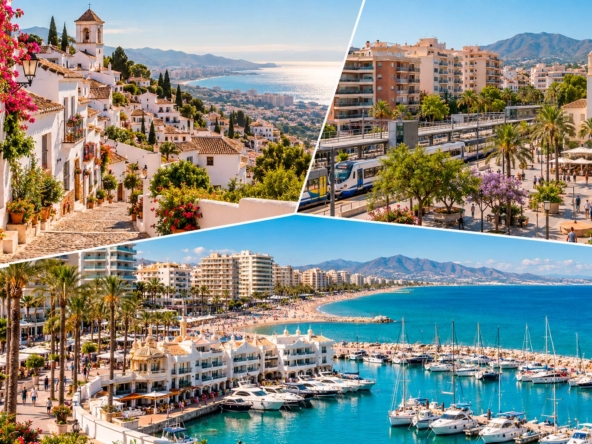
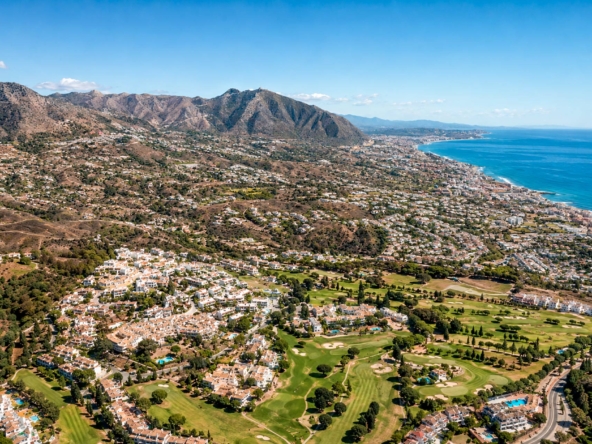
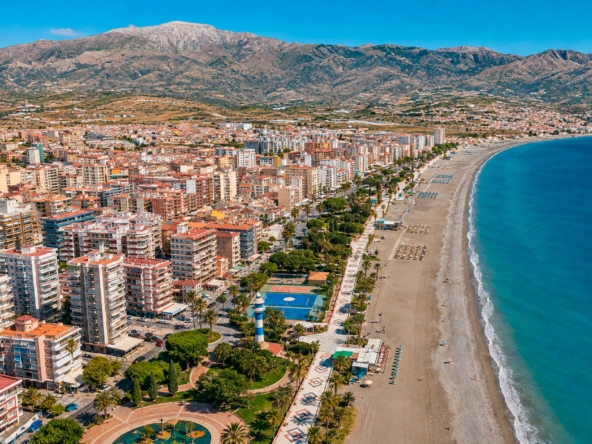
 by Plaza Estates
Nerja is a sun-drenched coastal town on the eastern Costa del Sol, 56 km from Málaga airport, home to around 22,000 residents — approximately a third of them foreign nationals from more than 90 countries. The town suits retirees, remote workers and families seeking authentic Andalusian life with easy international connections. Nerja remains one of the more expensive residential markets on the eastern Costa del Sol, with asking prices averaging around 3,852 €/m² (Idealista, April 2026), although comparisons vary depending on whether asking prices, registered sales or appraisal values are used.
Why Nerja?
Nerja’s appeal is its scale: small enough to walk everywhere, large enough to offer good restaurants, reliable healthcare and a genuinely multinational international community. Unlike much of the western Costa del Sol, Nerja was developed relatively lightly — there are no high-rise towers on the seafront, and the old town keeps its whitewashed Andalusian character.
According to Nerja’s municipal register (padrón), around a third of the town’s residents are foreign nationals — approximately 6,900 people from more than 90 nationalities. British residents form the largest group, at around 2,300, but what sets Nerja apart is how genuinely diverse its international population is: the Swedish community numbers around 930 residents, making it notably large for a town of this size, and there are significant German, Dutch and Belgian communities, alongside residents from across Northern Europe. The majority of foreign residents are in the 60–80 age bracket, reflecting Nerja’s longstanding reputation as a retirement destination — though the town is increasingly attracting younger remote workers and families too.
The Balcón de Europa — a clifftop promenade right above the sea — is the social centrepiece and one of the most photographed viewpoints in Andalusia. The surrounding coast offers a string of beaches: Torrecilla and Chaparil to the west, Burriana to the east, and the protected cove at Maro within the Maro-Cerro Gordo Natural Park, which regularly appear in Spain’s best-beach rankings.
Practical advantages stack up too: the urban area has full fibre broadband, and the established international community means English-language services are easy to find — though Swedish, German and Dutch speakers will also find their languages spoken in day-to-day life. Nerja is around 56 km from Málaga and is connected by regular bus services with Málaga city; airport connections may require changing at Málaga bus station depending on timetable. For a deeper look at what the area offers, see our Nerja travel and holiday guide.
Best Areas to Live in Nerja
Centro (Town Centre)
The historic core around the Balcón de Europa and Calle Pintada is the most walkable part of town. Supermarkets, the weekly market, beaches and restaurants are all within a 10-minute walk. Properties are mainly apartments and townhouses in older buildings. Entry prices may be more accessible depending on property type, condition and proximity to the sea, making Centro a good starting point for buyers wanting a central base.
Best for: buyers wanting full walkability; retirees; remote workers who rarely need a car.
Parador, Carabeo & Upper Burriana
Sitting on and around the clifftops east of the Balcón de Europa, this area takes in the residential streets near the Parador de Nerja hotel, the Carabeo beach cove below, and the elevated sections of the Burriana neighbourhood. It combines sea views, easy access to both the old town and Burriana beach, and a residential quality that draws buyers seeking both lifestyle and long-term value. This tends to be one of Nerja’s most sought-after stretches, and prices can vary significantly depending on floor level, orientation, sea views and specific location within the area.
Best for: buyers prioritising sea views and easy access to both the centre and the beach; those looking at the top end of the Nerja market.
Torrecilla, Chaparil & Punta Lara
To the west of the Balcón de Europa, this stretch runs along the seafront toward Torrecilla beach, taking in the Chaparil residential neighbourhood and Punta Lara. It is well served by beach access and popular with buyers looking for apartments with holiday-rental potential. Entry prices may be more accessible than in the clifftop areas to the east, depending on property type, floor level and proximity to the beach, though prices vary considerably across the area.
Best for: buyers seeking beach access and vacation-rental potential; those wanting an apartment in a well-connected residential area.
Capistrano
Capistrano Village is a distinctive urbanisation of Moorish-inspired whitewashed terraced houses about 1 km from the centre, with communal pools and landscaped gardens. It has been popular with British buyers for decades and has a well-established expat community with its own social calendar. Prices in Capistrano can sit above the municipal average, but the area often offers more space, communal facilities and a quieter residential setting than the most central or beachfront locations.
Best for: buyers who value space, communal amenities and a close-knit residential community.
Burriana
The lower Burriana neighbourhood is centred on the beach of the same name at the eastern edge of town. It has a local, residential feel: quieter streets, good amenities and direct beach access. Ayo’s paella restaurant on Burriana beach is a local institution. Prices can vary significantly within the area depending on proximity to the beach, views, orientation and property condition.
Best for: families; beach-lifestyle buyers; those wanting a quieter base without sacrificing access to town.
Maro
Maro is a small village 5 km east of Nerja, above the Maro-Cerro Gordo Natural Park. It retains a genuinely rural character — a village square, a handful of restaurants and very limited new development. Playa de Maro, one of the finest beaches on the Costa del Sol, is accessible on foot from the village. The market here is quieter and transaction volumes are low; properties can offer rural character and space at prices that vary considerably depending on the specific plot, views and access. For available properties, browse our Nerja property listings.
Best for: privacy seekers; nature lovers; buyers wanting countryside views close to a protected beach.
Cost of Living & Property Prices 2026
Nerja remains one of the more expensive residential markets on the eastern Costa del Sol. The Colegio de Registradores — which tracks actual closed transactions registered at the Land Registry — publishes the Málaga province benchmark each quarter in its Estadística Registral Inmobiliaria. The Ministerio de Transportes places provincial appraisal values (valor tasado) above 3,600 €/m² at year-end 2025. Nerja’s own ask-price average stands at 3,852 €/m² in April 2026, up 8.1% year-on-year (Idealista). Comparisons between these figures vary depending on methodology — asking prices, appraisal values and registered sale prices each reflect a different stage of the market.
| Reference point | Price / €m² | Source |
|---|---|---|
| Málaga province — closed transactions | See current Registradores bulletin | Colegio de Registradores (ERI, quarterly) |
| Málaga province — appraisal value (valor tasado) | >3,600 € | Ministerio de Transportes, end 2025 |
| Nerja municipality — ask price | 3,852 € | Idealista, April 2026 (+8.1% YoY) |
Within Nerja, prices vary considerably by location, property type, condition and views. Sea views, elevated position and proximity to the beach are the main value drivers, with clifftop properties east of the Balcón de Europa and beachfront access to the west both commanding premiums. No official body publishes closed-transaction data at neighbourhood level for a municipality of this size, so buyers should treat any zone-level figures as indicative of the direction of the market rather than a reliable guide to what any given property will achieve.
Day-to-day living costs are moderate for a Spanish coastal town:
- Coffee: €1.50–€2.00
- Menú del día (three-course lunch): €12–€16
- Monthly groceries (one person): approximately €300–€350
- Monthly utilities, electricity + water for a 2-bed apartment: €100–€150
- Private health insurance: from approximately €35/month for basic plans; comprehensive coverage typically €60–€100/month (providers include Sanitas and Asisa)
Healthcare, Schools & Connectivity
Healthcare. Nerja has a public Centro de Salud (state health centre) for residents registered with the Andalusian public health system (Servicio Andaluz de Salud, SAS). For private and English-language care, Nerja Medical Center — in the town centre — offers multilingual staff and 24/7 urgent services. The nearest general hospital is the Hospital de la Axarquía in Vélez-Málaga, roughly 35 km west (approximately 30 minutes by car). For specialist care, Málaga city’s Hospital Regional Universitario is approximately 56 km away. Many expats complement state healthcare with private health insurance.
Schools. State primary schools include Colegio Público Narixa, Colegio Público San Miguel and Colegio Público Joaquín Herrera; secondary pupils attend IES El Chaparil or IES Almijara. Andalusian state schools offer bilingual Spanish-English programmes at no extra cost. For families wanting an English-curriculum school, the nearest option is Almuñécar International School, approximately 25 km west in Almuñécar (Costa Tropical), which serves a catchment area that includes Nerja and Torrox. British and international schools in Málaga city offer more choice at approximately 56 km.
Connectivity. Nerja’s urban area has full fibre broadband (Movistar, Orange, Vodafone) with speeds of 600 Mbps or above available to most apartments and townhouses. Outlying properties — rural villas near Maro, hilltop sites — may rely on ADSL or 4G/5G fixed wireless. Mobile coverage is 4G/5G throughout the town.
Pros and Cons of Living in Nerja
Pros
- Authentic Andalusian character; no high-rise seafront development
- Excellent micro-climate: mild winters, around 3,000 sunshine hours per year — among the highest in mainland Spain
- Genuinely multinational community: ~6,900 foreign residents from 90+ nationalities (~33% of the population), with large British, Swedish and German populations
- Málaga approximately 45–50 minutes by car; regular bus connections
- Strong ask-price growth: +8.1% year-on-year (Idealista, April 2026)
Cons
- Nearest international school 25 km away in Almuñécar
- Limited local employment for non-remote workers
- Property prices have risen sharply; quality entry-level stock is limited
- No direct train; car is the most practical option for most journeys
- Specialist hospital 35 km away; major hospital 56 km
Frequently Asked Questions
Is Nerja a good place to retire?
Yes — Nerja is consistently cited as one of the top retirement destinations on the Costa del Sol for Northern European buyers. The walkable old town, mild climate and authentic Spanish character suit a relaxed pace of life well. Crucially, the town’s international community is genuinely diverse: British, Swedish, German, Dutch and Belgian residents have all put down roots here over decades, so new arrivals rarely feel isolated regardless of their background. Málaga airport means family visits from the UK, Scandinavia and Northern Europe are straightforward, and the town has good private medical options for those not covered by the Spanish state system.
What are Nerja’s property prices in 2026?
The most recent Idealista data puts Nerja’s ask-price average at 3,852 €/m² (April 2026, +8.1% year-on-year). For broader context, the Colegio de Registradores publishes closed-transaction prices across Málaga province each quarter in its Estadística Registral Inmobiliaria — figures that reflect actual sale prices rather than advertised asking prices. Within Nerja, prices vary significantly by area, property type and condition; sea views, clifftop position and beach proximity are the main value drivers.
Do I need to speak Spanish to live in Nerja?
Practically, no — English is widely spoken in shops, restaurants and professional services, and Swedish, German and Dutch speakers will also find their languages used in daily life. However, basic Spanish improves daily life considerably, and some official processes (residency applications, notarial procedures) require the involvement of a bilingual professional or sworn translator.
How far is Nerja from Málaga airport?
Nerja is around 56 km from Málaga airport, roughly 45–50 minutes by car via the A-7/AP-7. Regular bus services connect Nerja with Málaga city; airport connections may require a change at Málaga bus station depending on the timetable. There is no direct rail link.
Can non-Spanish nationals buy property in Nerja?
Yes. EU and non-EU nationals buy with the same rights as Spanish citizens. You will need an NIE (Número de Identificación de Extranjero), a Spanish bank account and a solicitor. Budget for purchase costs of approximately 8–11% on top of the sale price: this covers ITP transfer tax (7% in Andalusia for resale properties, as set by the Junta de Andalucía, subject to reduced rates in specific cases), notary and land-registry fees, and legal representation. Your solicitor can advise on which rate applies to your purchase.
Ready to explore property in Nerja? Browse our full listings and area guide at plazaestates.es/city/nerja/, or contact our local team directly:
Plaza Estates
+34 952 524 191 · [email protected]